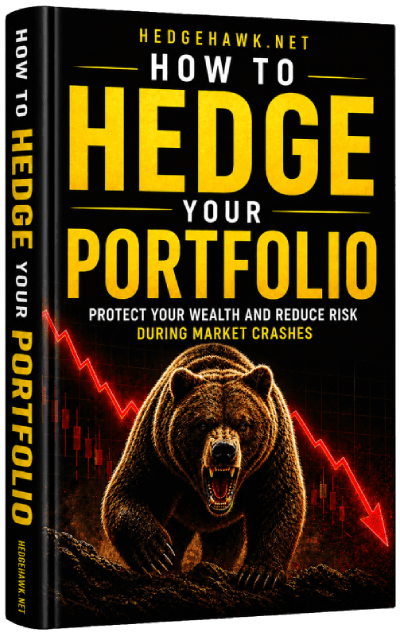
Free Sample Available · Defensive Investing Guide
How to Hedge Your Portfolio
Before the Next Market Downturn
A 50% loss requires a 100% gain just to break even. Most investors learn this the hard way. This hands-on guide blends market history, behavioral finance, and systematic risk-monitoring to show you exactly how to protect your portfolio before the next crash, not after.
As an Amazon Associate, HedgeHawk earns from qualifying purchases.
Free sample of the first two chapters on Amazon Kindle.
Grade level 13 = college freshman. Written for self-directed investors, not finance professionals.
Historical perspective
Major U.S. market declines since 1970
Sound familiar?
You've felt this before, and it cost you.
Selling near the bottom, only to watch the market recover without you.
Warning signs were everywhere, yet you had no systematic way to act on them.
The reality: ignoring protection is always more expensive after the fact.
Market timing is a myth. Systematic protection is not. There's a difference.
Is this for you?
This book was written for people in exactly your situation.
Most investing books focus on picking stocks. This one focuses on not losing your shirt when the market turns against you. If any of the cards on the right describe you, this book was written with you in mind.
This is not a book for day traders or speculators. It's for people with long-term money they cannot afford to lose permanently.
You're in index funds, 401(k)s, or ETFs and want to keep growing without a 50% drawdown wiping out a decade of progress.
Sequence-of-returns risk is real. A crash in the first years of retirement can permanently derail withdrawals. This book shows you how to defend against it.
You manage your own portfolio and want an objective, systematic way to know when to add protection, without relying on gut feel or financial media.
You've lived through 2008 or 2020 and sold at exactly the wrong time. You refuse to let it happen again but aren't sure what to do differently.
Real-world case study from Chapter 1
Two investors. Same crash. A $65,000 gap.
In 2007, Sarah and Michael both had ~$110,000 invested in S&P 500 index funds. Same market. Same starting point. Very different outcomes. The only difference was a 2% annual hedge.
No hedge. Panic-sold to cash. Locked in a permanent loss. Missed the entire recovery.
Same market conditions.
Same crash. Same recovery.
Different outcome.
Stayed invested. Kept compounding through the recovery. New highs by 2010.
The full story, including the sequence-of-returns analysis for retirees, is in Chapter 1. The first two chapters are free to sample on Amazon.
Inside the book
A complete playbook for defensive investors
31 chapters. Every stage of portfolio defense. Here are the ones readers say changed how they think about risk.
Two investors. Same crash. Same starting balance. One walked away $65,000 ahead. Find out why and why it had nothing to do with stock picks.
Most investors think hedging means predicting crashes. It doesn't. What it actually means might surprise you.
The best time to add protection has nothing to do with what the market is doing. It comes down to four personal questions most investors never ask.
Spending too much on protection can quietly destroy your returns, even when nothing bad happens. There's a number that keeps you safe without the drag. This chapter finds it.
Professional fund managers can't time markets consistently. Neither can you. There's a better approach, and it costs far less than waiting.
You can do everything right and still lose money on a hedge. Six predictable mistakes claim most investors, and every one of them is avoidable.
What if you could set a maximum loss on your portfolio in advance? Protective puts let you do exactly that. Here's how to choose the right one.
There's a technique that can fully protect your downside for little to nothing out of pocket. Most investors have never heard of it, or don't believe it works.
Lockups, tax bills, insider rules, emotional attachment: there are a dozen reasons you can't just sell. This chapter shows how to protect what you can't exit.
The hedge was fine. The investor wasn't. Six mental traps cause more portfolio damage than most crashes, and most investors don't see them coming.
Every investor has a loss threshold that triggers a panic sell. Most don't know what theirs is until it's too late. This chapter helps you find it before the next crash.
Everything in the book distilled into a single, repeatable playbook. Build it once. Follow it without thinking. That's the whole point.
Chapters 4–6 & 15–17: Practical tools and frameworks
Every hedging strategy you need, explained clearly.
The book walks you through each tool step by step, from the simplest beginner-friendly approaches to more advanced techniques, so you can build exactly the level of protection that suits your portfolio and risk tolerance.
Hold a defined percentage of your portfolio in cash or money market funds. When markets fall, you have dry powder to buy more and a psychological anchor that prevents panic selling.
The original hedge. Spreading across uncorrelated assets and rebalancing on schedule automatically forces you to sell high and buy low, reducing peak-to-trough drawdowns without any options knowledge.
Exchange-traded funds that rise when the market falls. No options account required. A small allocation (e.g. 5-10%) to an inverse S&P 500 ETF can meaningfully offset broad market drawdowns.
Buy a put option on SPY or your holdings. If the market falls below your strike price, the put gains value and offsets portfolio losses. This is exactly what Michael used in the $65,000 case study: 2% of his portfolio annually.
Combine a protective put with a covered call. The call premium offsets the cost of the put, making downside protection nearly free in exchange for capping some upside. A favourite of institutional investors.
Reduce the cost of buying protection by combining a long put with a short put at a lower strike (a bear put spread). You pay less in premium and still cap your downside risk within a defined range, making protection affordable even in low-volatility environments.
What the book challenges
Hedging myths that are costing you money
Every one of these sounds reasonable. Every one of them has cost investors real money. How many do you believe right now?
Paying a 2% annual premium feels like a drag. Watching your unhedged portfolio fall 40% and then selling near the bottom because you can't take any more pain is not cheap. The book calculates the actual cost of both. The comparison is not close.
This plan requires you to be right about timing twice: once when you sell, and again when you buy back in. Research tracking 30 years of retail investor behavior shows that most people get both wrong, and the gap between market returns and what investors actually earn is almost entirely explained by these two mistakes.
The largest pension funds in the world use put options to protect their portfolios. So do endowments, insurance companies, and institutional asset managers. They are not speculating. They are insuring. A protective put is not a bet the market will fall. It is a policy that pays out if it does, and it costs a fraction of the loss it prevents.
In normal markets, spreading across asset classes genuinely reduces risk. In a systemic crash, it doesn't. In 2008, U.S. stocks, international stocks, real estate, and corporate bonds all fell at the same time. The correlations that diversification depends on collapsed in exactly the crisis that needed them most. The book explains why this keeps happening and what actually works when it does.
You do not buy homeowners insurance because you expect your house to burn down. You buy it because the financial consequence of being wrong without coverage is catastrophic. A hedge is the same principle applied to your portfolio. The goal is not to profit from a crash. It is to survive one without making a permanent, irreversible decision at the worst possible moment.
Investors consistently overestimate their loss tolerance during calm markets and underestimate it during real ones. A 30% drawdown in a statement is a number. Watching it happen in real time, with financial news screaming crisis and no clear bottom in sight, produces a different reaction. The book helps you find your actual threshold before you discover it the hard way.
The most effective first steps cost nothing. Capping any single position at 10%, keeping a cash buffer, and removing margin debt are structural hedges that apply at any portfolio size. The book works through these free protections in detail before ever introducing a paid instrument, because most investors skip them entirely and go straight to expensive solutions for problems they created themselves.
A hedge that expires worthless means the market didn't crash. That is the outcome you were hoping for. Framing an unexpired premium as a loss is the same logic as saying your homeowners insurance was a bad deal because your house didn't burn down. This single mental reframe is what separates investors who stick with a protection strategy from those who abandon it right before they need it most.
What you'll walk away with
Your complete defensive investing toolkit
The core insight
"Recovering from a 50 % loss requires a 100 % gain. Hedging is not about beating the market. It's about staying in the market when it matters most, and letting compounding do its work while everyone else is licking their wounds."
From Chapter 6: Protect First. Grow Second.
Not ready to buy yet?
Get the free weekly HedgeHawk risk brief
A short, data-driven brief in your inbox every Friday, plus an extra alert when market risk climbs. Free, always.
- Weekly brief every Friday, plus an alert when the Hedge Score climbs above 55
- Includes the Hedge Score + concise insight
- Zero spam. Unsubscribe anytime.

About the author
Built by the team behind HedgeHawk.net
HedgeHawk is a daily market risk monitoring platform that aggregates volatility, options positioning, credit spreads, yield-curve data, safe-haven flows and drawdown signals into a single composite 0-100 risk score. The platform is completely free for everyone, whether or not you purchase the book. It's used by long-term investors who want an objective, systematic way to know when elevated market risk warrants portfolio protection, without relying on gut feeling or financial media noise.
This book is the definitive guide to everything the platform was built on: the signals, the behavioral science, and the practical frameworks that turn a warning score into a clear hedging action.
Ready to protect your portfolio?
Get the book today
Available now on all major platforms. Read a free sample of the first two chapters before you buy.
Available now on Amazon Kindle
As an Amazon Associate, HedgeHawk earns from qualifying purchases.
Buy on Amazon KindleFree sample of the first two chapters available on Amazon.
🛡 Refund policy
Not satisfied? Amazon Kindle offers a 7-day return window. Simply request a return through your Amazon account.
Questions
Frequently asked
The next downturn is not a question of if. It's when.
Will you be ready?
Protect your capital. Control your emotions. Stay invested through the recovery. Read the first two chapters free on Amazon.
As an Amazon Associate, HedgeHawk earns from qualifying purchases.
Free sample available • HedgeHawk.net is always free for everyone
© 2026 HedgeHawk • Dashboard • Privacy Policy • Disclaimer
This book is for informational and educational purposes only. Nothing herein constitutes financial advice. See our full disclaimer.